
Garden Automation
Garden Automation
Section titled “Garden Automation”Current services:
- Plant watering system
- Plant nutrient dispenser
- Network connected reverse osmosis system
- Environmental monitoring (temperature, humidity, soil moisture)
- Central water bus for efficient water distribution
Network Topology
Section titled “Network Topology”The central focus has been bringning all these systems online and integrating them with Home Assistant for unified control and monitoring. The water bus allows for efficient distribution of water to all the different systems, while the environmental monitoring provides valuable data to optimize plant care. Let’s look at each component in more detail:
Water Bus Hardware
Section titled “Water Bus Hardware”The water bus is the backbone of the garden automation system, allowing for efficient distribution of water to all the different systems. Essentially, it creates a network for water distribution, with the water switches acting as the “routers” that direct water to and from the various “devices” (plants, nutrient dispenser, reverse osmosis system, etc.). This setup allows for easy expansion and reconfiguration of the garden automation system as needed. Let’s look at each component in more detail:
Reverse Osmosis System
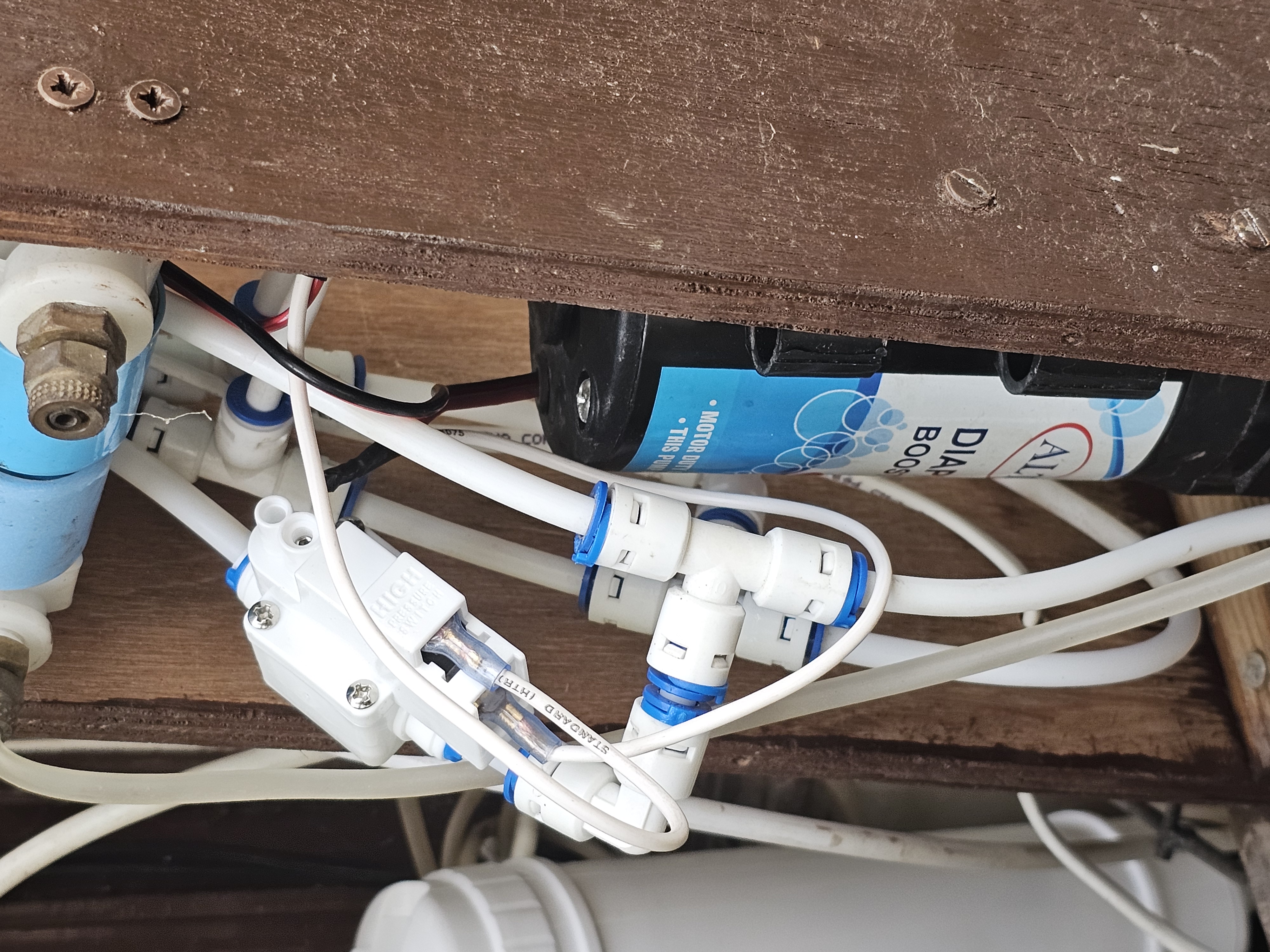
Section titled “Reverse Osmosis System”The reverse osmosis system is connected to the water bus and provides purified water for the plants. It is equipped with sensors to monitor water flow rate, and can be controlled remotely via Home Assistant. It has a high pressure switch set to 20 PSI to protect the system from damage.
Water Switches
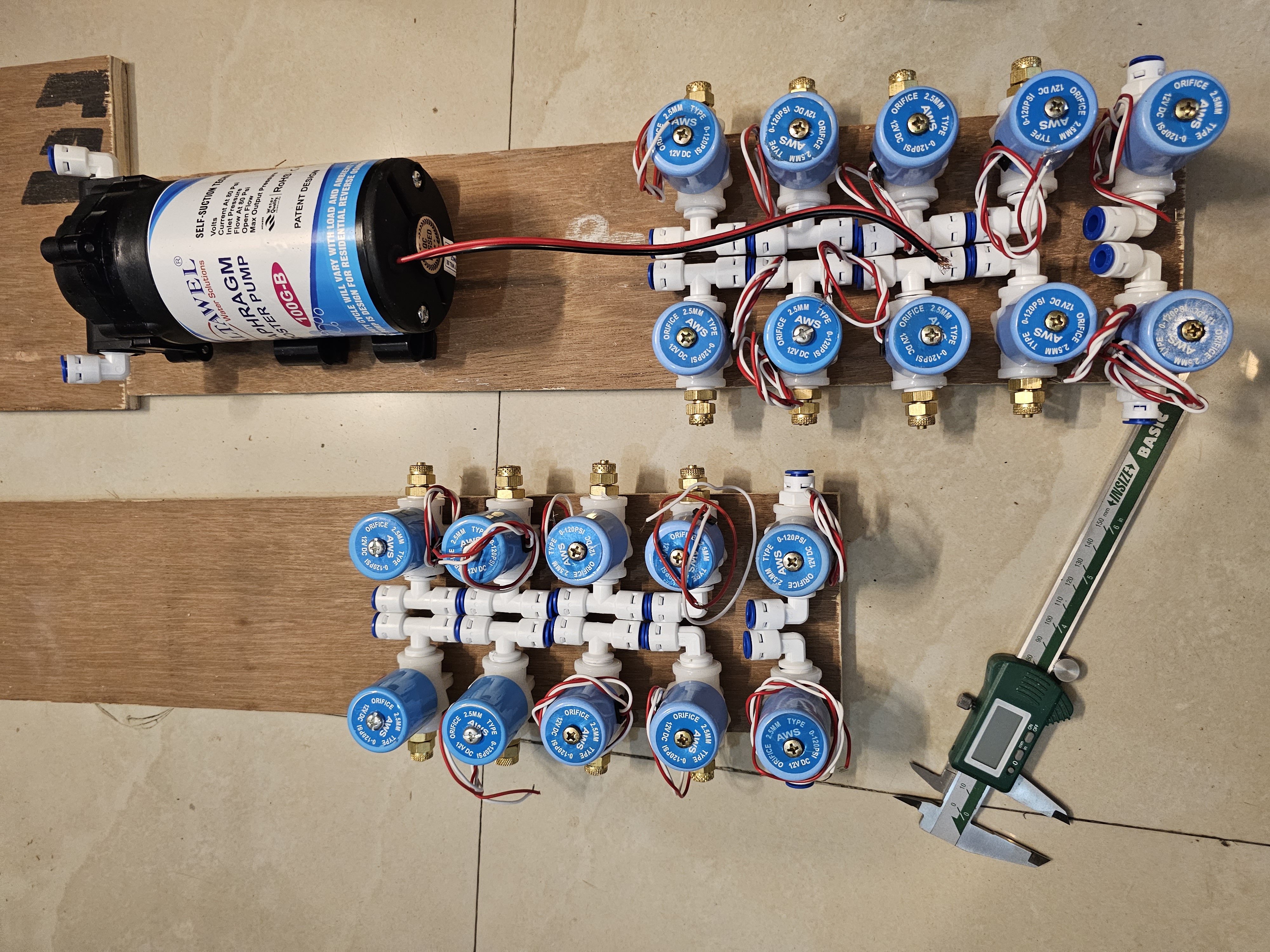
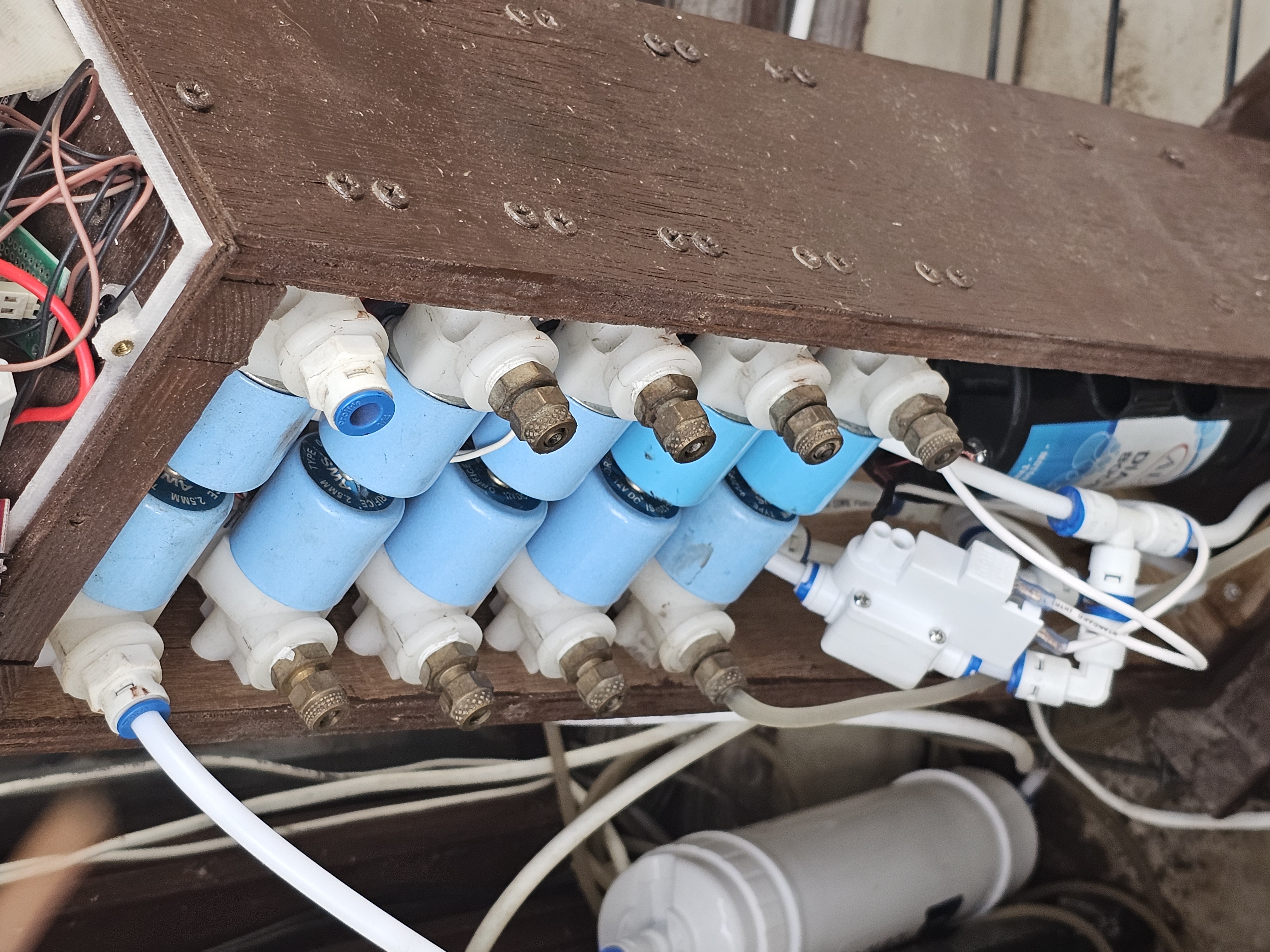
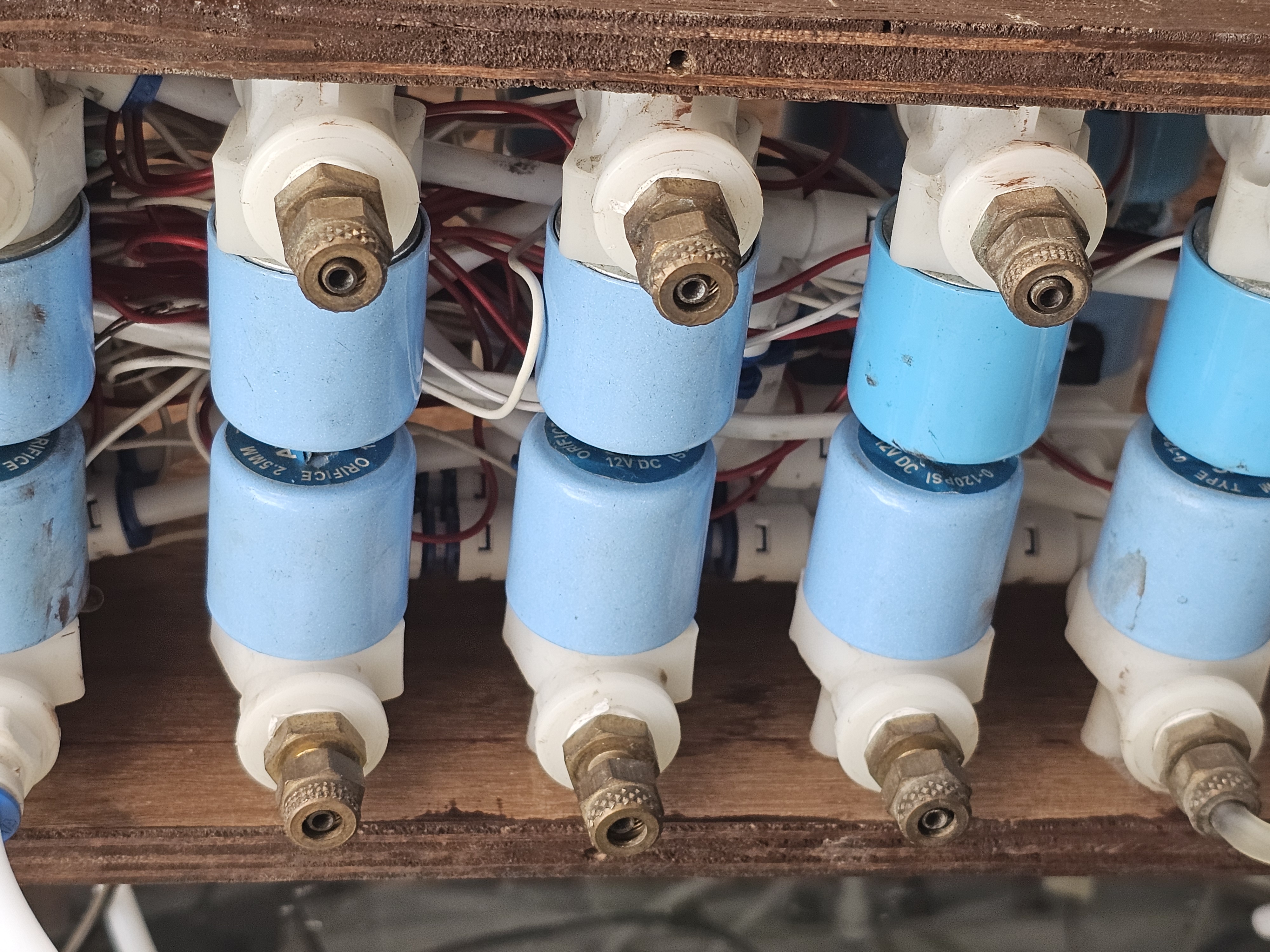
Section titled “Water Switches”The water switches are responsible for controlling the flow of water to the different systems. Each unit has 16 ports, allowing for a large number of connections. They are connected to the water bus and can be controlled remotely via Home Assistant. This system is analogous to a network switch, but for water instead of data. It allows for efficient distribution of water to all the different systems in the garden. We currently have 2 water switches, one for outside and one for inside, providing a total of 32 ports for water distribution. The outer unit also has 4 additional ports which are pressurized to 60 PSI for use with mist irrigation systems, allowing for growth of moisture loving plants in dry conditions.
Water Quality Monitoring Station
Section titled “Water Quality Monitoring Station”Water quality monitoring system contains sensors for measuring pH, electrical conductivity (EC), and total dissolved solids (TDS) and turbidity. This data is crucial for ensuring optimal growing conditions for the plants. The monitoring station is connected to the water bus via switch and can be accessed remotely via Home Assistant. The pH sensor is monted on a motorized arm which can be lowered into the water for measurements and then raised back up, moved and stored in potassium chloride solution to prevent damage to the sensor when not in use. It also has a air bubbler to help with auto cleaning of the sensors after each measurement.
Smart Jars
Section titled “Smart Jars”The smart jars can be used to store and dispense any kind of liquid. They level sensors help monitor the liquid level. These join the water bus via the switch and are currently being used to store clean water for use later. They have a solenoid valve to control the flow of liquid out of the jar. Since the jars have their own solenoid valves, many of these can be connected to a single port on the water switch, allowing for efficient use of the available ports on the water bus. They can also be used to hold RO waste water for gray water use.
Hydroponic Jars
Section titled “Hydroponic Jars”The hydroponic jars are also fitted with level sensors just like smart jars, but they also have air stones at the bottom to keep the nutrient solution oxygenated for the plants. They are connected to the water bus via the switch. There also is an aluminium water block dipped in the jar which can be fed with hot or cold water to help maintain the nutrient solution at an optimal temperature for plant growth. There is a temperature sensor in the jar to monitor the nutrient solution temperature. These jars are insulated to help maintain a stable temperature without needing to use too much energy for heating or cooling.
Challenges and Future Plans
Section titled “Challenges and Future Plans”Let’s talk about all that has gone wrong and future plans for this system. What I can say is, the system was dreadful in the past but has been improving consistently over time. And as more and more features start working reliably, I am getting more and more excited about the potential of this system.
Valve Issues
Section titled “Valve Issues”This system has been prone to leaks and stuck valves, which has been a major challenge as it can get the plant killed. The valves are simply of very poor quality control. A lot of them have been to found clogged due to misaligned spring. Another maojor cause of stuck valves has been rust in solenoid plunger itself (!!). Overall, this system uses about 40+ such valves and all of them need to work in order for this system to work at all. I have been experimenting with servo based valves using cheap #D printed parts and it liiks promising so far. I also intend to design a 3D printed manifold that can distribute water to multiple ports with just a few stepper motors. Reducing the amount of copper needed per port is essential to make this system more affordable and scalable.
Free-wheeling Diodes
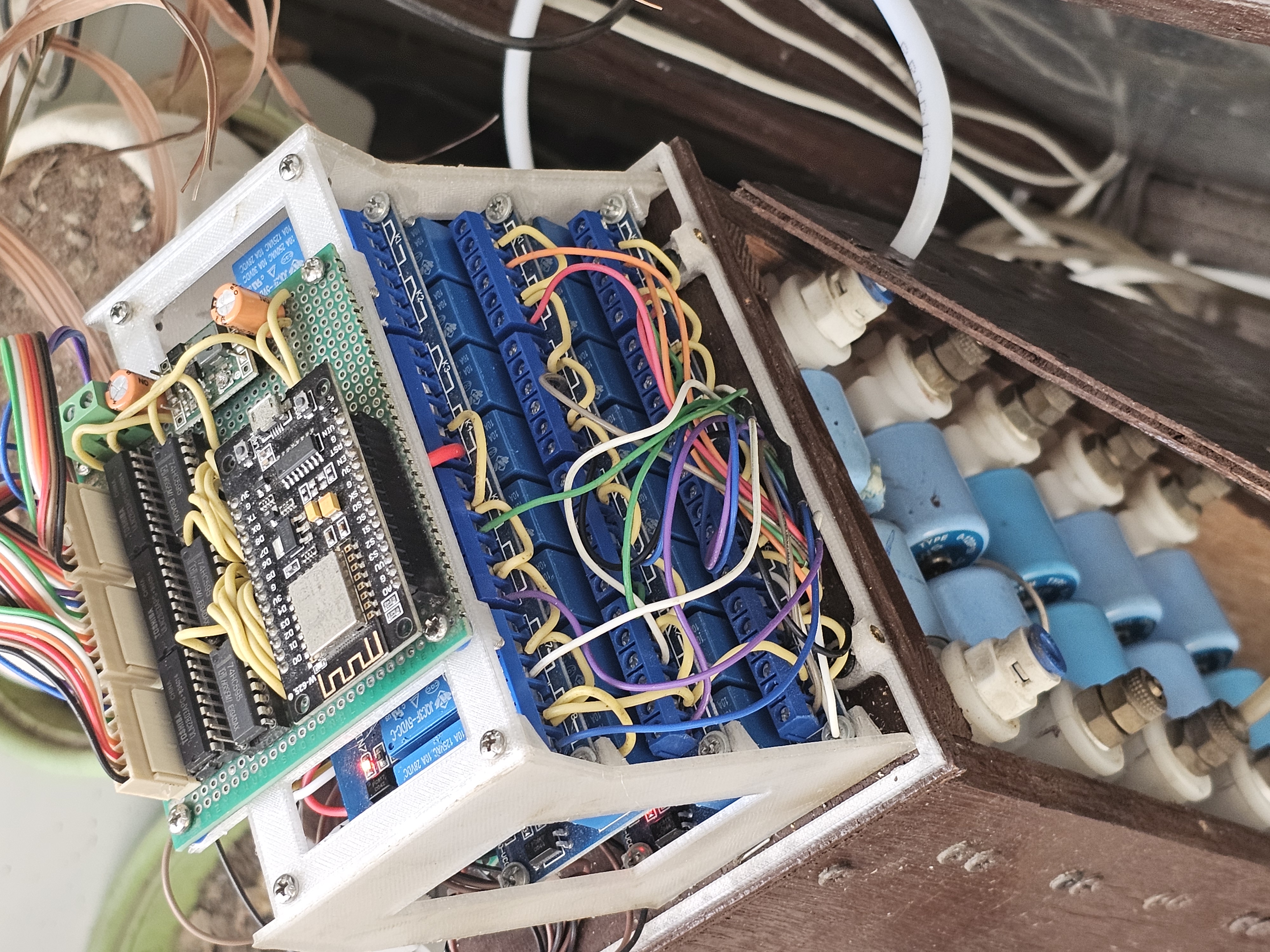
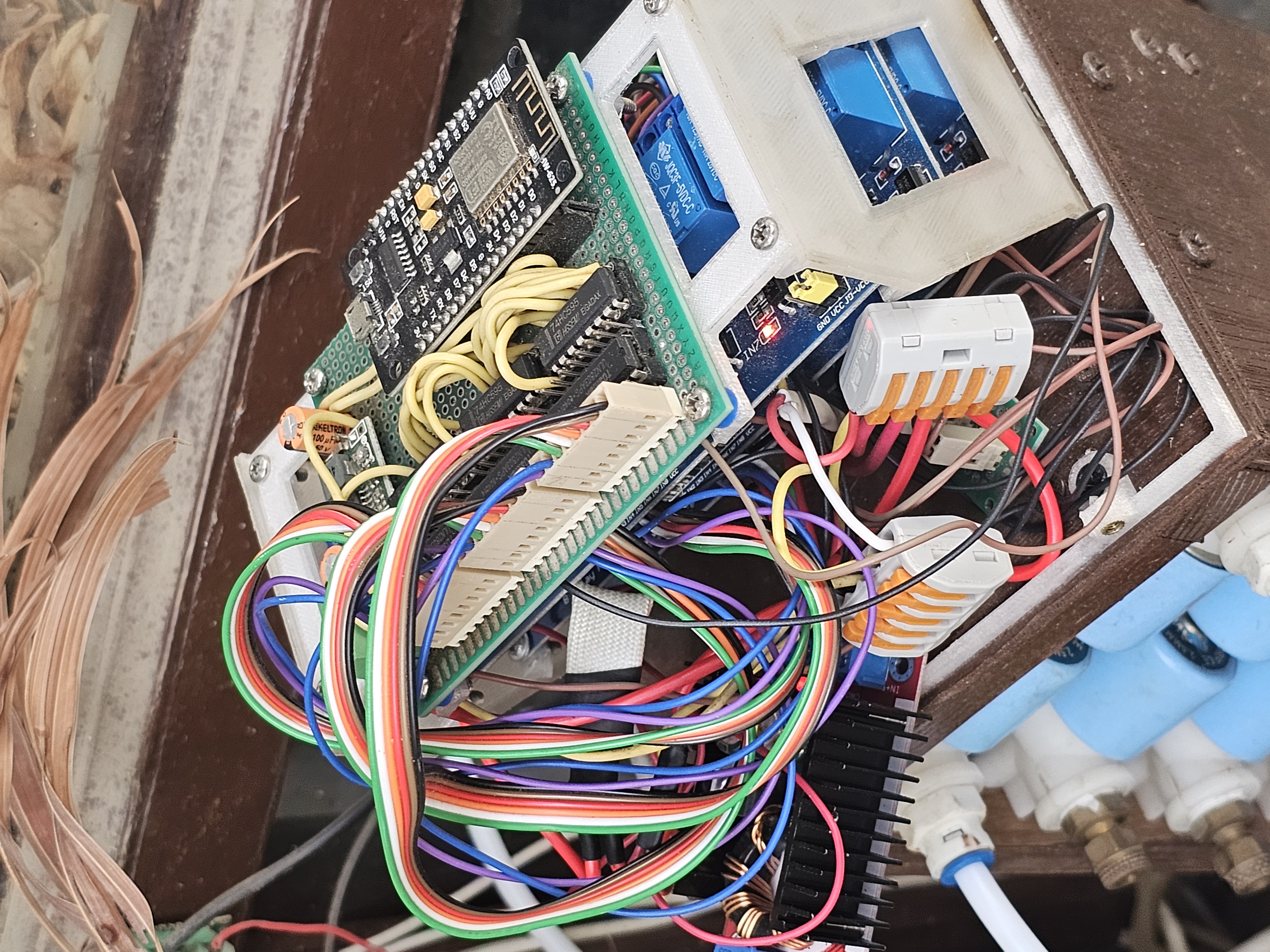
Section titled “Free-wheeling Diodes”I initially intended to use ULN2083A darlington arrays to control the valves, but I found that the free-wheeling diodes in those ICs were not sufficient to handle the inductive load of the valves, leading to blown ICs. I immediately placed an 8 channel relay board after the main board’s darlington arrays. This was done as I really was running out of time. The relay boards do not have any means to deal with the inductive load of the valves, but at least they do not get damaged when the valves are switched off. This was injecting a lot of noise into the system rails causing instability and random resets in ESP8266. Massive amounts of trouble was caused by this. I then added 1N4007 diodes across each valve to provide a path for the inductive kickback current, and this has significantly improved the stability of the system. No more random resets.
They may sound trivial but leaks can cause massive finanicial and human loss. Fires, building damage, wood rot, mold, etc. Since this system has large number of connections, leaks are very frequent. Currently, there is no system to detect leaks. I have flooded my bedroom and my balcony multiple times due to these leaks. Addidng high pressure switch did help in reducting leaks massively. Some of the valves leak slowly at high pressure and so this switch prevents that entirely. I placed the pressure pump at the bottom most part of the system to keep the center of gravity low and reduce chances of tipping over. But this ensured that is there’s any leak, water will fall on the pump. I recently damaged one pump just like this. For now, I’ll cover the pump with a sheet of plastic to protect it from leaks. I also intend to add spill sensors in critical areas to detect leaks early and prevent damage.